

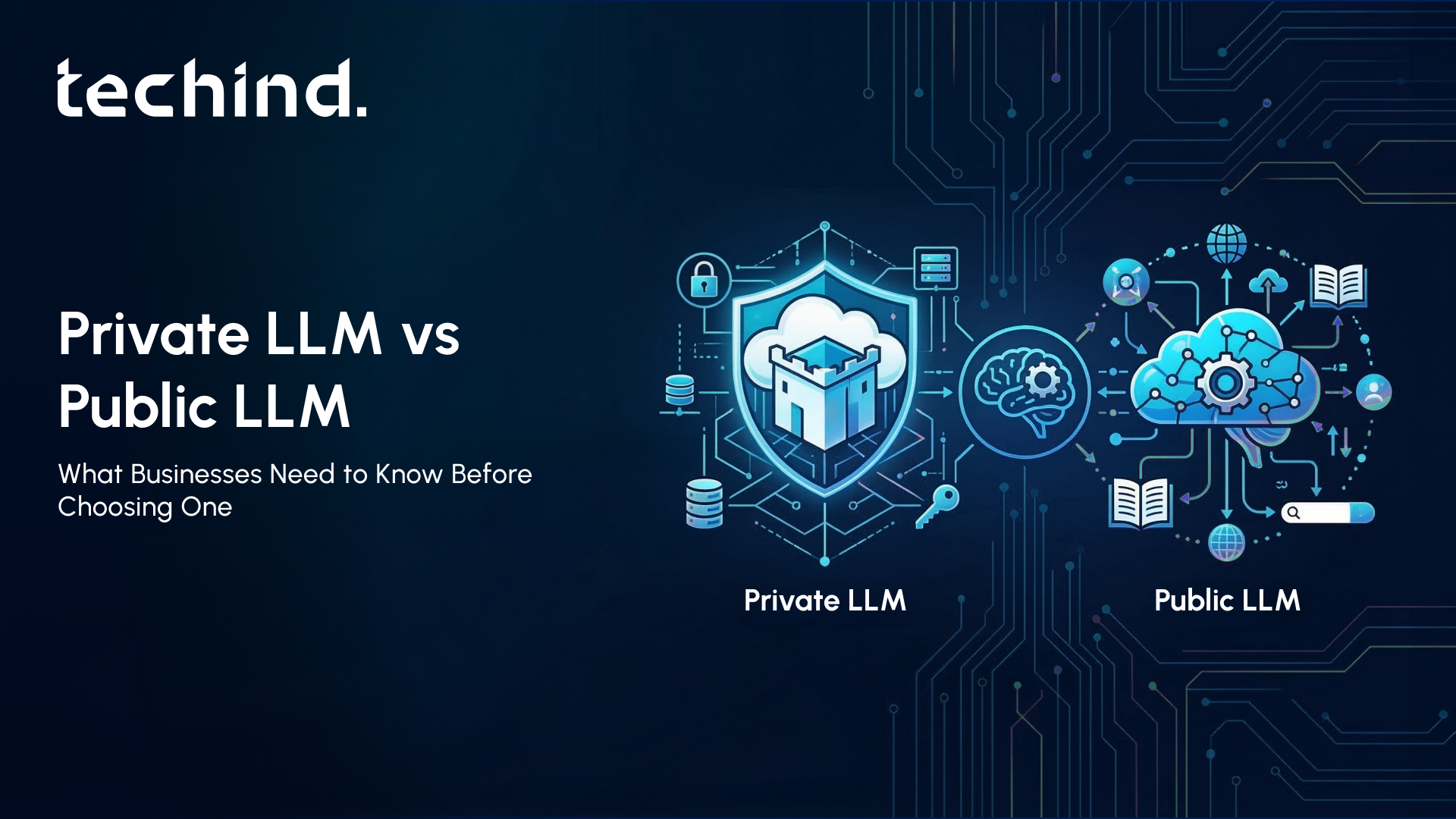
Artificial intelligence has moved from being an experimental tool to becoming part of everyday business operations. From writing content to helping developers code and assisting customer service teams, large language models (LLMs) are now used across industries.
But as companies begin to integrate these models into their workflows, a key decision appears: should they use a public LLM or invest in a private LLM?
Both approaches offer strong capabilities, yet they serve different needs. The right choice depends on factors like data privacy, cost, control, and the type of applications a company wants to build.
This blog explains the difference between private and public LLMs, how they work, and which option makes sense for different business scenarios.
Large language models are AI systems trained on massive datasets to understand and generate human-like text. They can answer questions, summarize information, generate reports, translate languages, write code, and assist in decision-making.
Many organizations today use these models through cloud-based services. Others build and host their own models within their internal infrastructure.
The difference between public and private LLMs lies mainly in where the model is hosted, how data is handled, and how much control organizations have over it.
Public LLMs are models that are hosted by AI providers and accessed through APIs or web platforms. Businesses can use them without managing infrastructure or training models themselves.
Examples include widely used models like ChatGPT, Claude, Gemini, and others available through cloud platforms.
These models are trained on extremely large datasets and are designed to handle a wide range of tasks.
1. Ready-to-use models
Public LLMs are available instantly. Companies can integrate them into applications using APIs without building the model themselves.
2. Large-scale training
These models are trained on vast datasets collected from books, websites, and other public sources, which gives them broad knowledge.
3. Managed infrastructure
The AI provider manages servers, updates, model improvements, and performance optimization.
4. Pay-as-you-use pricing
Businesses typically pay based on the number of tokens, API calls, or usage volume.
Public LLMs offer several benefits for companies that want quick access to AI capabilities.
Fast implementation – businesses can integrate AI tools within days instead of months.
Lower upfront costs – no need to build infrastructure or train models.
Continuous improvements – providers regularly upgrade models and improve performance.
High scalability – the infrastructure supports millions of requests.
Because of these advantages, public LLMs are widely used in applications like chatbots, marketing content generation, coding assistance, and data summarization.
Despite their convenience, public models come with some concerns.
Data privacy risks if sensitive information is sent to external servers
Limited customization for industry-specific knowledge
Dependency on external providers
Ongoing usage costs
For organizations handling confidential data, these issues can become critical.
A private LLM is a model that is deployed within an organization’s own infrastructure or a dedicated cloud environment. The company has full control over how the model is trained, accessed, and used.
Private LLMs are often built using open-source models such as LLaMA, Mistral, or other transformer-based architectures. These models are then fine-tuned using company data.
The goal is to create an AI system that understands the organization's domain knowledge and internal processes.
1. Full data ownership
All training data and interactions remain inside the organization’s environment.
2. Custom training
The model can be trained using company documents, reports, customer interactions, or industry datasets.
3. Controlled access
Only internal teams or approved systems can use the model.
4. Infrastructure management
The organization manages compute resources, updates, and security policies.
Private LLMs offer benefits that are important for enterprises dealing with sensitive or regulated data.
Higher data security since data never leaves the internal environment
Domain-specific accuracy through customized training
Better control over compliance and governance
Reduced long-term API costs for heavy usage
Industries like healthcare, finance, defense, and government often prefer private LLM deployments because of strict data protection requirements.
However, private LLMs require greater effort to implement.
High initial investment in infrastructure
Need for AI and ML expertise
Ongoing model training and maintenance
Longer deployment time
Organizations must evaluate whether the benefits outweigh these costs.
Understanding the main differences helps businesses decide which model fits their needs.
|
Factor |
Public LLM |
Private LLM |
|
Deployment |
Hosted by AI providers |
Hosted by the organization |
|
Data Control |
Limited |
Full control |
|
Customization |
Limited fine-tuning |
Deep customization |
|
Implementation Speed |
Very fast |
Slower |
|
Infrastructure |
Managed by provider |
Managed internally |
|
Cost Model |
Pay per usage |
Higher upfront, lower long-term cost |
Each approach serves a different purpose depending on business goals.
Public LLMs are ideal for organizations that want to experiment with AI quickly or deploy general-purpose AI tools.
Common use cases include:
Customer service chatbots
Content writing assistance
Code generation for developers
Marketing automation
Internal productivity tools
For startups and small teams, public LLMs reduce complexity and allow rapid experimentation.
Private LLMs are better suited for organizations where data privacy, security, or specialized knowledge is critical.
Examples include:
Healthcare systems analyzing patient records
Financial institutions processing transaction data
Legal firms reviewing confidential documents
Manufacturing companies using internal operational data
Private models can also power internal knowledge assistants trained on company documents.
Many enterprises now use a hybrid approach, combining both public and private models.
In this setup:
Public LLMs handle general tasks like writing or summarization.
Private LLMs manage sensitive data or internal workflows.
This allows companies to balance cost, performance, and security while taking advantage of both systems.
Hybrid AI architectures are becoming common as organizations expand their AI capabilities.
Adoption of enterprise AI continues to grow rapidly.
According to market research:
The global AI market is expected to exceed $1.8 trillion by 2030.
Around 35–40% of companies are already using AI in some form, while many others are planning deployments.
Enterprise demand for custom and private AI models is rising as data governance becomes a priority.
These trends show that businesses are moving beyond experimentation and building AI systems tailored to their operations.
Before selecting a public or private LLM strategy, organizations should evaluate several factors.
1. How sensitive is the data being processed?
If confidential data is involved, a private model may be safer.
2. How much customization is required?
Industry-specific workflows often require specialized training.
3. What is the expected usage scale?
Heavy usage can make private models more cost-effective.
4. Does the organization have AI infrastructure and expertise?
Private models require engineering resources.
The choice between private and public LLMs is not about which one is better overall. It is about which one fits a company’s needs, data environment, and long-term AI strategy.
Public LLMs provide speed, convenience, and powerful capabilities that make AI accessible to businesses of all sizes. Private LLMs offer greater control, security, and customization for organizations handling sensitive data or complex internal systems.
As AI adoption grows, many enterprises will likely combine both approaches, building hybrid AI ecosystems that balance flexibility with security.
For companies planning their AI roadmap, understanding the differences between these two models is the first step toward making the right decision.


Discover tailored solutions. Connect with our experts today.
 INDIA EUROPEAN UNION
Copyright © Techindo Systems Private Limited | Privacy Policy | Terms & Conditions


