

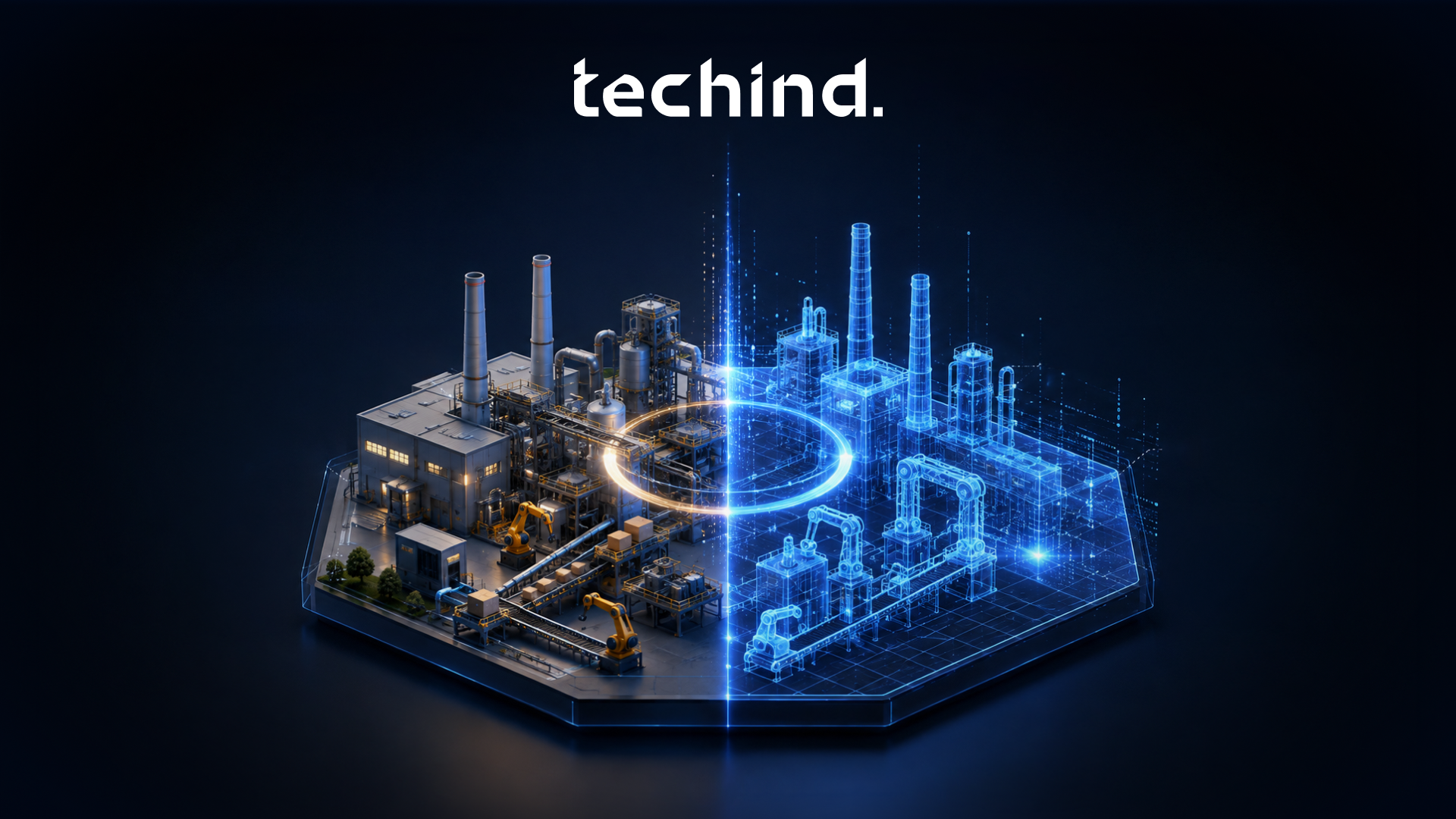
Say you want to test a production change. A new line layout. A different maintenance schedule. Normally that means gambling with real output, real machines, and sometimes real people. Now imagine running the whole experiment on a virtual copy of your operation first, watching exactly what breaks and what improves, then walking over to the actual line only once you already know the answer.
That copy is a digital twin: a living virtual replica of your operation you can push, stress, and rebuild as often as you like without losing a minute of production. And in 2026, digital twin manufacturing is quietly turning into standard equipment rather than a lab curiosity.
The market tells the story better than any pitch. Digital twins are projected to grow from around $36 billion in 2025 to roughly $180 billion by 2030. That works out to a compound annual growth rate close to 38%, with industrial manufacturing sitting right at the center of it. Patent filings jumped 600% between 2017 and 2025. Whatever you want to call this, it stopped being a science project a while ago. It looks a lot more like an arms race, and nobody wants to be the plant that shows up late.
Adoption is already deep in the industries that live and die by their equipment. More than 70% of manufacturers in automotive, aerospace, electronics, and energy are piloting or running digital twins today. Pharma, chemicals, and food and beverage are not far behind, somewhere between 30% and 50%.
The reason is simple. The returns are real. Companies using digital twins report:
When a single hour of unplanned downtime can run into the hundreds of thousands, a virtual model that helps you dodge even a handful of those hours pays for itself in a hurry. The math is not subtle.
Here is the part most vendors gloss over. A digital twin is only as good as the science running underneath it. A pretty 3D model spinning on a screen is just an expensive dashboard. The value shows up when you pair that model with operations research, the discipline of optimization, simulation, and modeling, and then layer AI on top of live data pouring off the floor.
That combination changes the whole point of the thing. Instead of simply mirroring your operation, the twin starts telling you what to do next. Where to relieve the bottleneck. When to pull a machine for service before it actually fails. Which of three layout options squeezes out the most throughput without adding a single square metre.
The clear trend this year is toward unified platforms that pull data, software, and hardware into one place, so teams can collaborate across the entire value chain at once instead of trading spreadsheets. Add AI to that, and smart manufacturing starts to look genuinely adaptive. You end up with production systems that tune themselves, factories that adjust on the fly instead of waiting for someone to notice a problem three shifts too late.
None of this is something you switch on and forget. The two biggest obstacles have very little to do with the technology itself. They are data governance and whether your organization is actually ready to change how it makes decisions.
Feed a twin messy, siloed data and it will hand you confident nonsense, which is arguably worse than no answer at all. Clean foundations and clear ownership are what separate a slick demo from a deployment that survives contact with the real world. It is unglamorous work. It is also, more often than not, the whole difference.
Operations research and digital twins are home turf for us. At Techind, we combine advanced optimization models, simulation, and digital twin technology to help enterprises cut costs, push efficiency higher, and make smarter calls across genuinely complex operations. Decisions grounded in science, not guesswork, and ones you can actually stand behind when someone asks why.


Discover tailored solutions. Connect with our experts today.
 INDIA EUROPEAN UNION
Copyright © Techindo Systems Private Limited | Privacy Policy | Terms & Conditions


